What Time Was It 12 Hours Ago? Calculate the Exact Time

What Time Was It 12 Hours Ago? Calculate the Exact Time. You glance at the clock. Your brain just asks it out of nowhere. What time was it 12 hours ago? It happens more than you think, especially when you’re tired or jet lagged.
Good news. This one is way easier than it feels in your head right now. No hard math. No confusing steps. Just flip AM to PM, keep the minutes, and you’re basically done. Let’s walk through it together in plain, simple words.
What Time Was It 12 Hours Ago? Understanding the Core Idea of Time Shift
Here’s the short version. To find 12 hours ago from now, you just flip AM to PM or PM to AM and keep the same minutes. That’s it. No complicated time subtraction formula needed for a normal 12 hour jump.
This works because a full day has 24 hours, and 12 hours is exactly half of that. So going back 12 hours always lands you in the previous half of the day.
If it’s 3:00 PM right now, 12 hours earlier was 3:00 AM. Same minutes, opposite half of the day, done.
What Time Was It 12 Hours Ago? Step by Step Time Calculation Guide
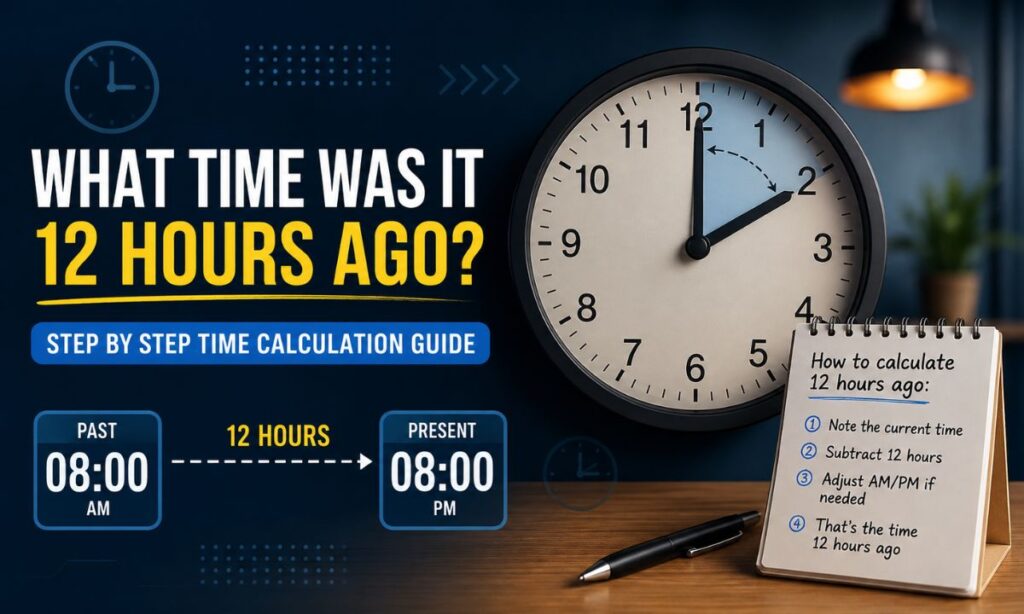
Let’s break down how to calculate 12 hours ago so you can do it in your head without thinking twice.
Step 1: Look at your current time and note if it’s AM or PM.
Step 2: Keep the minutes exactly the same. They never change in a 12 hour shift.
Step 3: Switch AM to PM, or PM to AM. That single swap does most of the work.
Step 4: Check if you crossed midnight or noon, because that changes whether it was today or yesterday.
Here are a few real examples using this time calculation method:
- Current time 6:34 PM becomes 6:34 AM, same day
- Current time 1:00 AM becomes 1:00 PM, previous day
- Current time 11:59 PM becomes 11:59 AM, same day
- Current time 12:00 PM (noon) becomes 12:00 AM (midnight), previous day
- Current time 12:00 AM (midnight) becomes 12:00 PM, previous day
Notice the pattern. Anytime your current time is before noon, 12 hours ago rolls back into yesterday. Anytime it’s after noon, it stays on the same day. That’s the whole trick behind previous day calculation versus same day calculation.
Why AM and PM Flip When You Subtract 12 Hours
This part trips people up more than the math itself.
A 12 hour clock only has two halves, AM and PM. Since 12 hours is exactly one half of a full day, subtracting it always bumps you into the other half.
Think of it like flipping a coin. Heads becomes tails, AM becomes PM. There’s no in between with a clean 12 hour jump.
This is different from something like subtracting 5 hours, where you might stay in the same AM or PM zone depending on your starting point. With AM PM conversion for a full 12 hour shift, the flip is guaranteed every single time.
What Time Was It 12 Hours Ago in GMT+5: A Local Time Reflection
Let’s ground this in a real time zone. GMT+5 covers places like Pakistan, and the same 12 hour math applies there exactly the same way it does anywhere else.
If it’s 6:34 PM in GMT+5 on a Wednesday, 12 hours ago was 6:34 AM that same Wednesday morning. The time zone difference itself doesn’t change how you calculate 12 hours ago, it only matters if you’re comparing two different time zones to each other.
Here’s a common mix up. People sometimes think GMT+5 time needs a special formula. It doesn’t. The 12 hour subtraction rule works the same no matter which time zone you’re standing in, because you’re comparing a time zone to itself, not to a different one.
Where time zones actually matter is when someone in GMT+5 is trying to figure out what time it was 12 hours ago for a friend in a totally different zone, like GMT+0 or GMT-5. That’s a separate calculation involving the time offset between two places, not just a simple 12 hour subtraction.
Converting 12 Hours Into Smaller Units
Sometimes you want to see the number behind the number. Here’s the full breakdown using basic hours to minutes conversion:
- 12 hours in minutes equals 720 minutes
- 12 hours in seconds equals 43,200 seconds
- 12 hours in milliseconds equals 43,200,000 milliseconds
You’ll almost never need seconds or milliseconds for a real life question like this. But it’s a fun fact for anyone who wants the full time arithmetic picture, or anyone building something technical that needs exact unit time conversion.
Tools, Calculators, and the Modern Way of Thinking About Time
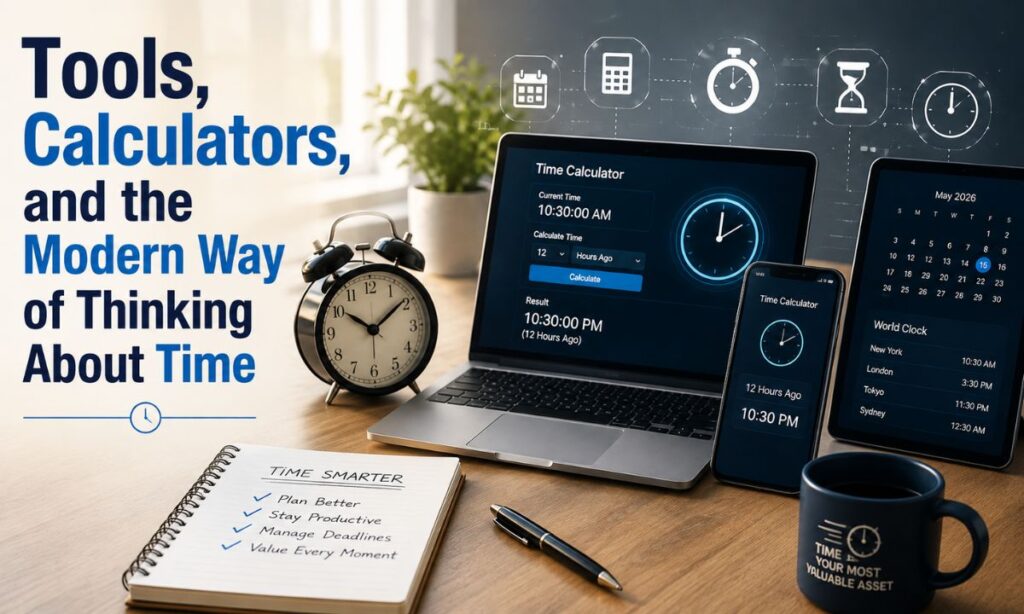
You don’t have to do any of this by hand if you don’t want to. A good time difference calculator or hours from now calculator will do it instantly.
Type in your current time, hit subtract, and boom, you’ve got your exact time 12 hours ago without lifting a mental finger.
Still, plenty of people like doing the current time minus 12 hours math themselves. There’s something satisfying about not needing an app for something this simple.
If you ever want to double check your own math, running it through an online time calculator once or twice is a smart habit. It builds confidence so next time you can just do it in your head.
RAED NORE: How Long Until 3:00 PM? Live Countdown & Time Remaining Today
Common Mistakes in Subtracting 12 Hours
Even though this math is basic, people mess it up in the same few ways over and over. Here’s what to watch for.
Mistake 1: Forgetting the day changes. People often get the AM PM flip right but forget that crossing midnight means it was actually yesterday, not today.
Mistake 2: Mixing up noon and midnight. Noon is 12:00 PM and midnight is 12:00 AM. Mixing these two up throws off the whole answer.
Mistake 3: Changing the minutes by accident. The minutes never move in a straight 12 hour shift. Only AM and PM switch.
Mistake 4: Overcomplicating it. Some people try to convert everything into seconds and minutes for a question that only needed a simple AM to PM flip.
Keep it simple. Flip AM PM, keep the minutes, check if you crossed midnight or noon, and you’re basically done every time.
Why the 12 Hour Clock System Still Confuses People?
The 12-hour clock system resets twice a day instead of once, and that’s really the whole source of the confusion.
A 24-hour clock never repeats a number. 3 PM is just 15:00 and there’s no ambiguity at all. But on a 12 hour clock, 3:00 shows up twice a day, once in the morning and once at night, so your brain has to do extra work figuring out which one you mean.
This is exactly why AM to PM conversion and PM to AM conversion feel like a small mental speed bump, even for people who’ve used clocks their entire life. It’s not that the math is hard, it’s that the format itself asks your brain to track one more detail.
Some countries lean more on the 24 hour format for this exact reason, since it removes the guesswork completely. But the 12 hour clock isn’t going anywhere anytime soon, so knowing this trick is genuinely useful.
A Quick Trick for Remembering Which Day It Was
Here’s a shortcut that makes day boundary crossing way less confusing.
If your current time is anywhere from 12:00 AM to 11:59 AM, 12 hours ago was yesterday. If your current time is anywhere from 12:00 PM to 11:59 PM, 12 hours ago was today.
That one rule covers every single case. You don’t even need to think about the specific minutes to know which day you’re dealing with, just whether it’s currently morning or afternoon and evening.
Real Life Reasons People Ask This Question
Nobody asks what was 12 hours ago from now just for fun. There’s usually a real reason behind it.
Shift workers checking when their last shift actually started. Someone doing an elapsed time calculation for a work log or timesheet. A traveler trying to figure out what time it was back home before their flight landed.
Parents tracking a baby’s feeding schedule also ask this a lot, since half day gaps come up constantly with newborns. Even people taking medication on a schedule use this kind of past time calculation to stay on track.
Whatever the reason, the method stays exactly the same. Flip the AM or PM, keep the minutes, check the day.
Conclusion
So next time your brain randomly asks what time was it 12 hours ago, you already know the trick. Flip AM to PM. Keep the minutes the same. Check if you crossed midnight, and you’ll know which day it was too.
That’s really all there is to it. No calculator required, no stress, no overthinking. Though one is always there if you just want a quick double check. Simple math, simple answer, and now it’s stuck in your head for good.

Henry Brooks is the founder and lead writer behind TimyLaw, a trusted online resource dedicated to making measurements simple, accurate, and easy to understand. With a passion for turning complex dimensions, weights, lengths, and size comparisons into practical guides, Henry helps readers find real-world measurement answers quickly. Through TimyLaw, he creates well-researched, user-friendly content that explains everyday measurements using relatable examples, helping students, professionals, and curious readers make sense of sizes, distances, and weights with confidence. His goal is to provide clear, reliable, and engaging measurement content that makes learning both useful and enjoyable.